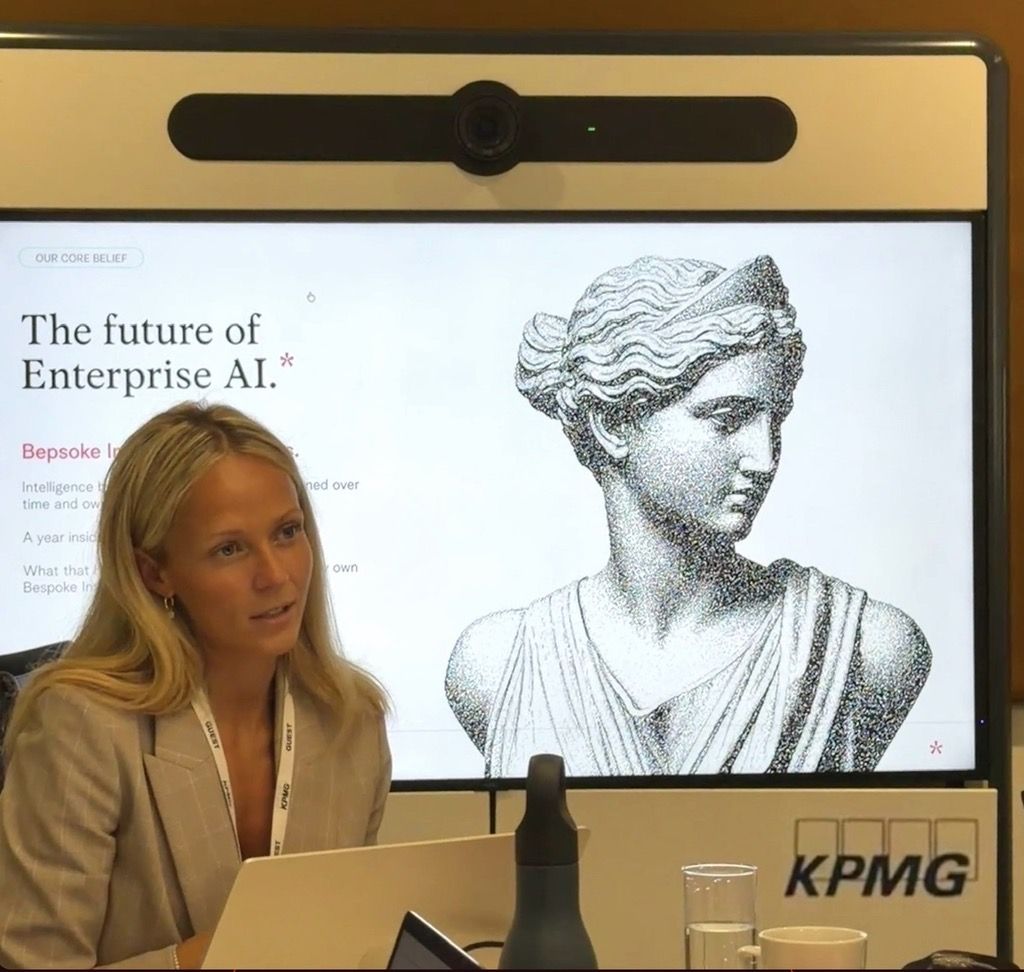
In September, I was invited to speak at KPMG’s FY27 planning session, to a room of Partners and Directors leading change across complex organisations.
They asked me to share what our first year in business had taught us. That year has been spent on the ground: inside 8 companies across a range of sectors, listening to more than 800 employees talk about what they need from AI, and building more than 350 agents, systems and automations around the way they actually work.
ApplyAI and KPMG operate at very different scales. But the conversation in that room kept returning to the same questions our clients ask us every week. How do we get real value from this? What should it cost? And how do we make it last?
Here is what I told them.
1. Access to AI is not an advantage
Every organisation can buy the same models, the same licences and the same tools as its competitors. Access is now table stakes.
The advantage comes from applying AI to what only your business has: its people, its knowledge, its workflows and its intellectual property. That is much harder to copy, because it took years to build.
It also means there is no off-the-shelf starting point. The work begins with understanding how the business really operates: where knowledge lives, where time is lost, and where judgement matters. Only then can you decide what to build.
2. Not every problem needs the most powerful model
Much of the discussion that followed focused on token costs and AI economics. It is a conversation more leadership teams need to have.
It is easy to point the largest, most capable model at every task. It is also expensive, and often unnecessary. Of the 350-plus systems we have built, many are not “AI” in the purest sense. Sometimes the right answer is an automation, a business rule or simply well-designed code. AI earns its place where it can interpret, synthesise and generate at scale.
Good AI economics means choosing the right technology for each task. The decision between AI, automation and code is now one of the most valuable a business can make well, because it determines what a system costs to run every day, not just what it costs to build.
3. The future of enterprise AI is connected
After a year of mapping workflows and codifying knowledge, we noticed something. The most ambitious AI programmes were all arriving at the same question: how do we connect it all?
Individual tools and agents deliver real gains. But on their own, they stay scattered. Our answer is what we call Bespoke Intelligence Systems: intelligence built around a business, improving with use, and owned by the organisation itself.
An Intelligence System brings together the people, knowledge, data, tools and workflows of a business through one intelligent core. It connects the tools people already use. It codifies how the organisation works. And it coordinates AI agents and automation, with people in control wherever judgement matters.
Crucially, it outlasts any one model. Models will keep changing. The organisational memory, workflows and operating logic built around the business remain, and that is where the lasting value sits.
Proving it on ourselves
We believed in this strongly enough to build one for ApplyAI. We call it Jarvis.
Jarvis brings together the knowledge, methods and ways of working our team has developed, and puts that collective intelligence to work across the business. It works alongside our experts and supports our major workflows.
I introduced Jarvis in the room at KPMG, and it drew a particularly warm response. I think that is because it makes the idea tangible: if a small consultancy can turn what it uniquely knows into a system its people use every day, so can any organisation.
What to ask before your next AI budget
As organisations plan for 2027, the temptation is to budget for licences and model access. That buys the same starting point as everyone else.
The stronger budgets will fund the complete system needed to turn AI into value. Four questions help shape that:
- What are we actually going to build?
- What will it take to keep it running reliably and economically?
- How will we give people the confidence to use it?
- How will we measure whether it is creating real value?
That last question matters most. We track every engagement through a bespoke ROI dashboard, so leaders can always answer the reasonable question: what are we getting back from all of this?
The models will change. The intelligence a business builds around its own people and knowledge should not.
If you’re working through these questions in your own organisation, we’d be glad to talk. Get in touch.